
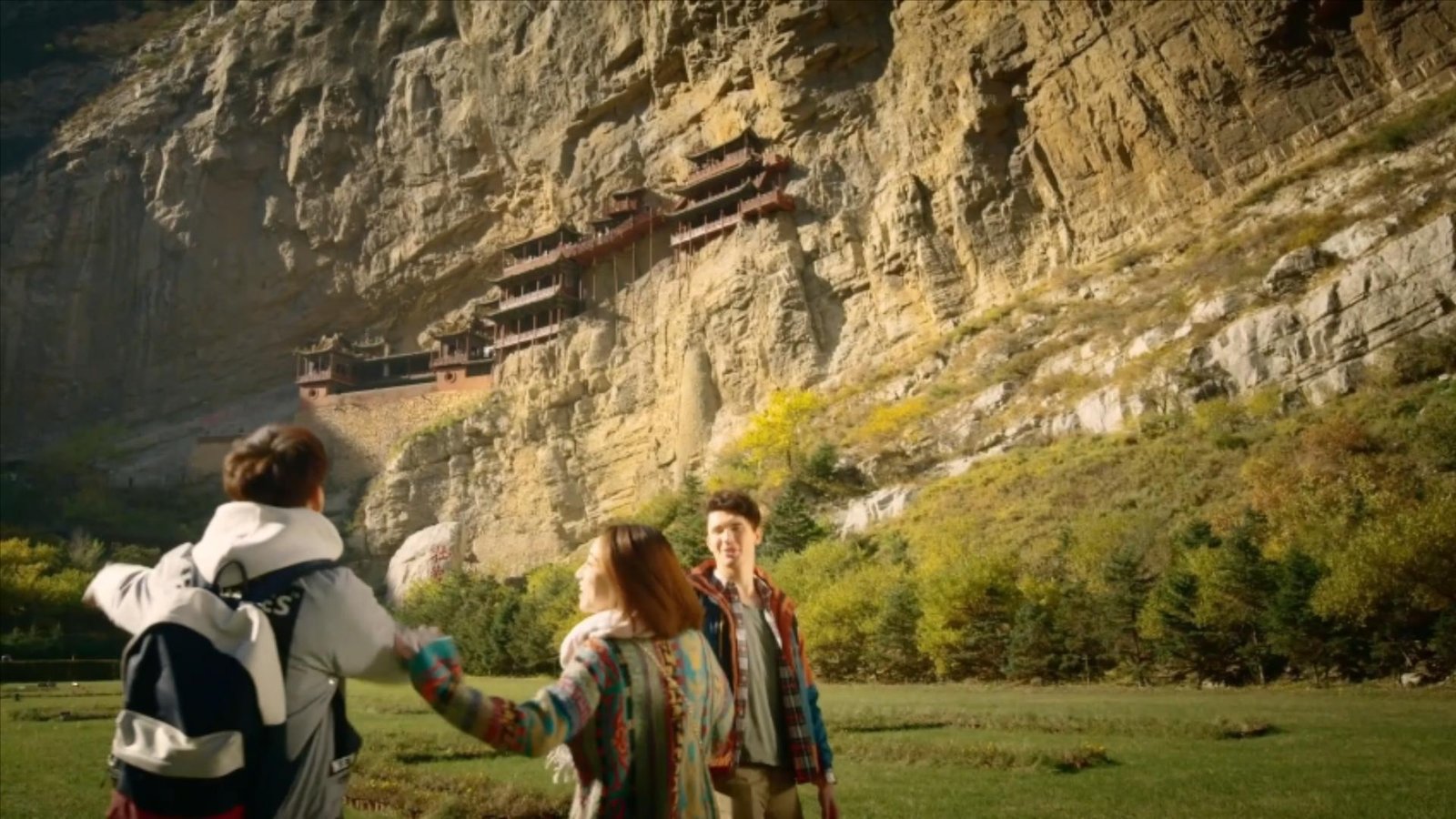
The Hanging Temple — China’s Death-Defying Marvel Clinging to a Cliff
Hengshan, Shanxi, China | Ranked Among the World’s 10 Most Dangerous Buildings | 1,400 Years Old
Let’s be honest: your brain will refuse to believe it at first.
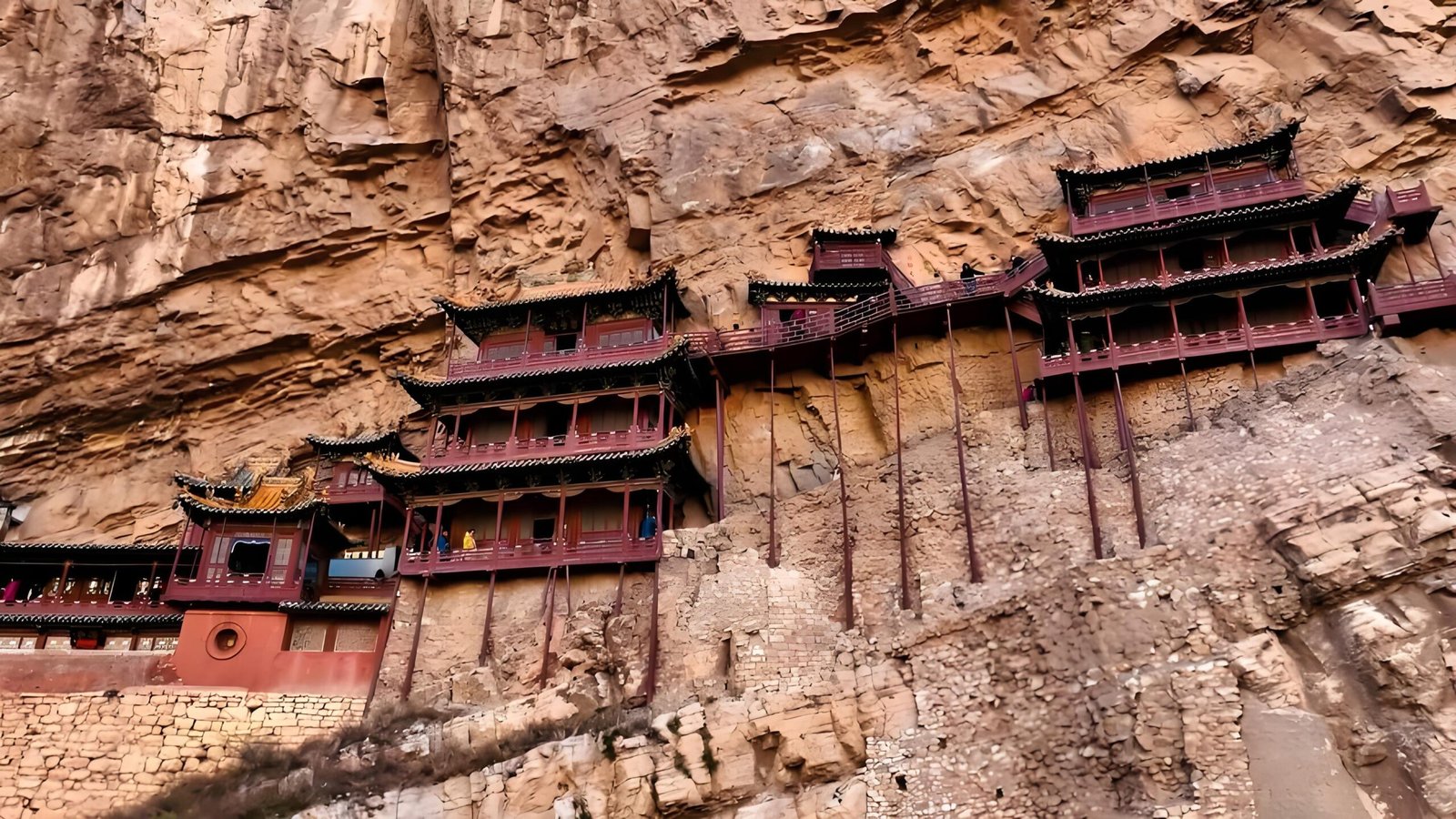
A temple — a real, multi-story, 40-hall temple — pinned to a sheer cliff face, suspended halfway up like it grew there. No ground underneath. Just wooden beams sunk into rock sockets, holding up halls, staircases, and 80 ancient statues against gravity and common sense for fourteen centuries. This is the Hanging Temple. And it has been defying physics since the Northern Wei Dynasty.
The Cliff That Became a Cathedral
Perched on the Cuiping Peak of Mount Hengshan, facing the towering Tianfeng Peak across a narrow gorge, the temple hangs at that uncanny midpoint between earth and sky where Taoist immortals were said to dwell. The location wasn’t chosen for drama (though you get plenty of it). It was chosen for stillness. Deep in the gorge, the temple is shielded from sun, wind, and flood — the very reasons it has outlasted empires.
The original structure dates to the late Northern Wei period (around the late 5th century), though most of what you see was rebuilt and refined during later dynasties. What hasn’t changed is the sheer audacity of the thing. The temple is almost entirely wood. The “secret” of its survival is deceptively simple: crossbeams driven horizontally into the cliff bear the load, while vertical pillars provide additional support. Weight is distributed so evenly across the structure that no single beam is overburdened. It’s not magic — it’s 5th-century engineering that still makes 21st-century architects reach for their notebooks.
Three Faiths, One Roof — Literally
Most temples pick a religion and stick with it. The Hanging Temple, with typical cliff-defying nonchalance, said: Why not all three?
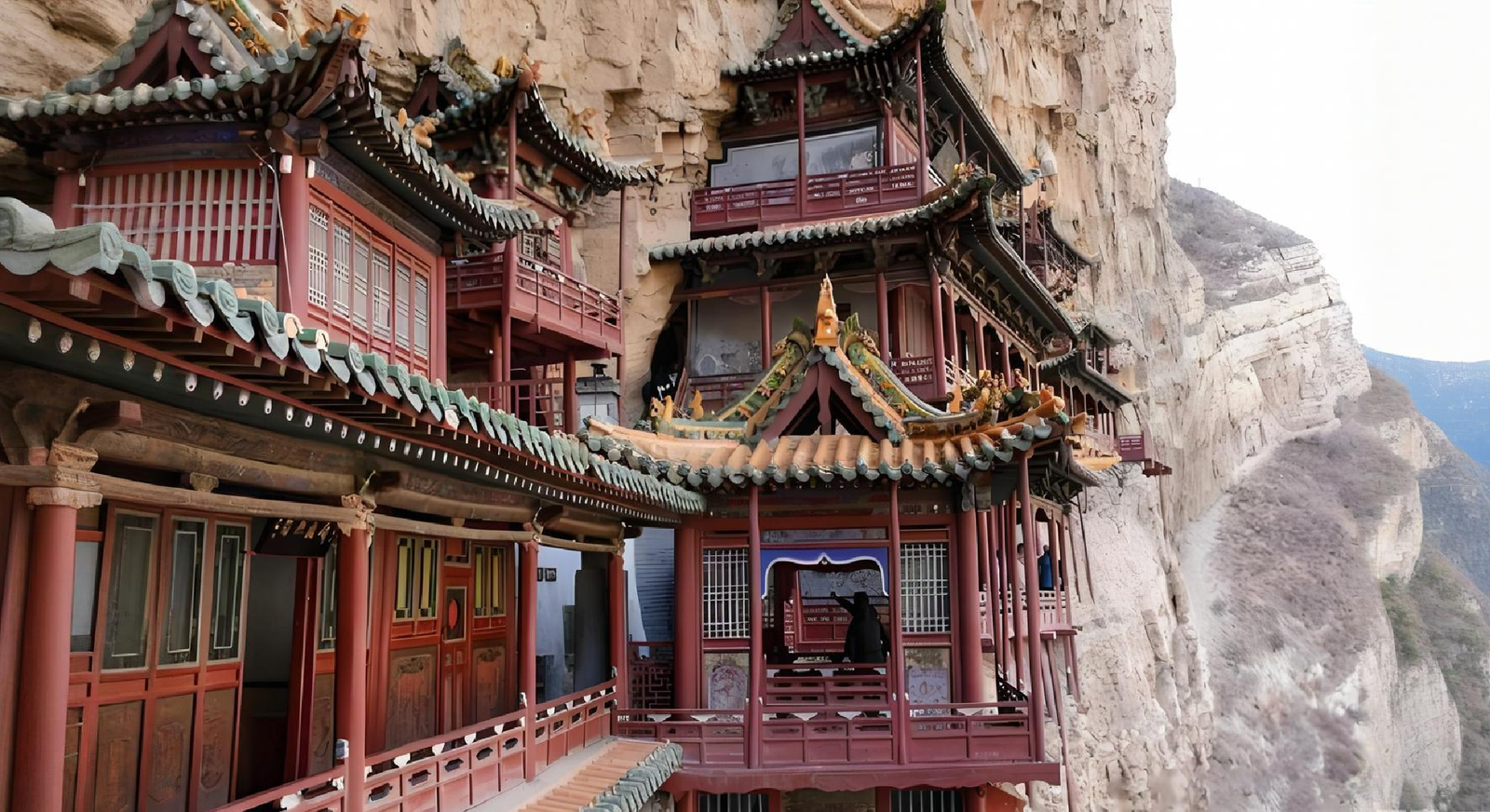
It remains China’s only surviving temple that houses Buddhism, Taoism, and Confucianism side by side — not in separate wings, but woven together across its 40 halls. You’ll find a serene Buddha in one room, Laozi contemplating the Dao in the next, and Confucian sages holding court upstairs. For a civilization that has often segregated its spiritual traditions, this is radical. It’s also deeply Chinese — a quiet insistence that different paths can lead to the same mountaintop, especially when that mountaintop is, well, halfway up a cliff.
The temple holds more than 80 sculptures spanning all three traditions. Walk slowly through the narrow corridors (some so tight you’ll need to turn sideways) and let the century-darkened wood, the creaking floors, and the sheer drop visible through the railing slats remind you: you are in a place that should not exist, and yet here you are.
The Greats Who Came Before You
You won’t be the first traveler to stand here, mouth slightly open, trying to process what you’re seeing.
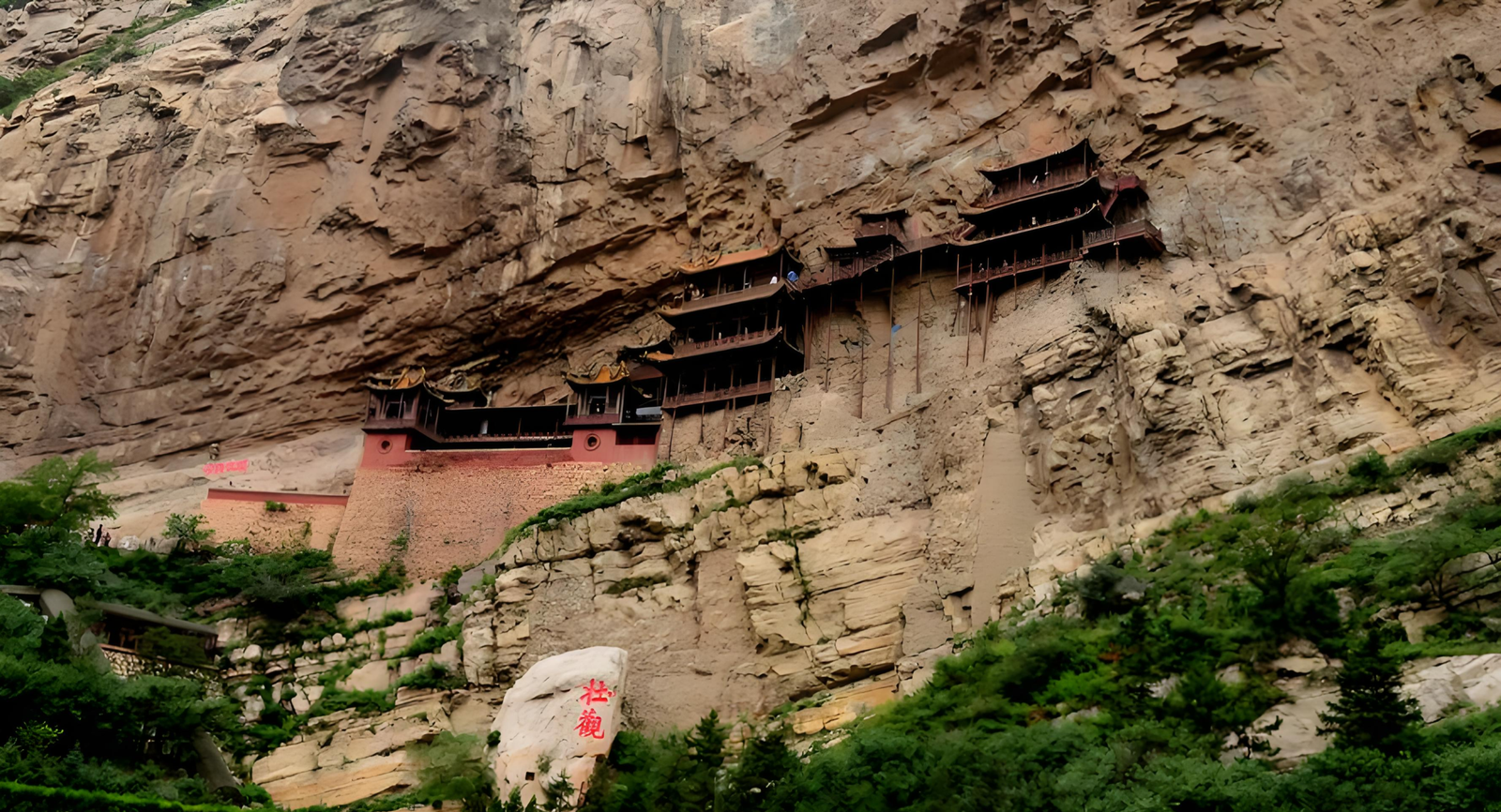
Li Bai — Tang Dynasty poet, legendary drunkard, the closest thing China has to a rock star — visited and was so moved he scrawled the characters “壮观” (Zhuàngguān, “A Grand View”) on a rock below. It’s still there. (Some say even Li Bai, never short of words, was too awestruck to write more.)
Xu Xiake — the Ming Dynasty’s answer to Marco Polo, a man who walked 30,000 kilometers across China documenting its wonders — included the Hanging Temple in his famous travel diaries, ranking it among the most extraordinary sights under heaven.
When a poet who could describe anything and a traveler who had seen everything both run out of superlatives, you know the place delivers.
What Your Visit Actually Feels Like
Let’s skip the brochure language. Here’s what happens.
You’ll approach through the gorge, and the temple will appear gradually — small at first, then increasingly impossible as you get closer. You’ll climb a series of steps cut into the cliffside. The wooden corridors are narrow, the railings low, and yes, your pulse will notice the drop. That’s part of the experience. The halls are intimate, candlelit, smelling of old wood and incense. The views across to Tianfeng Peak, with Mount Hengshan’s ridges rolling away into the distance, are the kind that make you stop and just… stand there.
Practical notes:
- The highest point sits about 50 meters above the gorge floor. It feels higher. It is higher.
- The temple is small but dense — you’ll need 1–2 hours to explore properly.
- Those with vertigo: the outer corridors are optional. The inner halls are still remarkable.
- Visit mid-morning when sunlight floods the gorge and the air is still crisp.
Mount Hengshan itself is one of China’s Five Sacred Mountains, so you’re getting a two-for-one: a legendary peak and humanity’s most gravity-defying act of worship.
Getting There
Datong is your gateway — the same city that gives you the Yungang Grottoes. Combine both in a single trip: the grottoes in the morning, the Hanging Temple the next day (it’s about 60 km southeast of Datong). High-speed trains from Beijing reach Datong in about two hours.
Spring and autumn offer the best weather, but winter visits have their own stark magic — the temple dusted with snow, the gorge silent, the incense smoke curling into frozen air.
Some temples you visit. This one you earn — step by suspended step, between earth and sky, where three faiths taught China that the only thing better than building a temple is building one that shouldn’t stand, but does.

EMBLÉMATIQUE
A 1,500-year-old monastery clinging to a sheer cliff face, 50 meters above the ground — the only temple in the world where Buddhism, Taoism, and Confucianism share one roof, literally suspended in midair.
BUZZ
Named one of TIME magazine’s “Top 10 Most Precarious Buildings on Earth” — featured in National Geographic and every architectural bucket list that dares to ask: how is this still standing?
REACH
60 km from Datong city center, ~90 minutes by car — perfectly paired with Yungang Grottoes for a single-day double-UNESCO-worthy loop.
CALENDRIER
Spring and autumn offer safest weather and crispest views — avoid rainy July–August (slippery cliffs) and icy winter (upper walkways may close).

MATCH
Thrill-seekers, architecture junkies, photographers chasing impossible angles, and anyone who prefers their temples vertical — not for severe vertigo or limited mobility.

VALEUR
~$20 USD — less than a movie ticket to walk inside a gravity-defying miracle older than the Great Wall, with no parallel anywhere on Earth.