
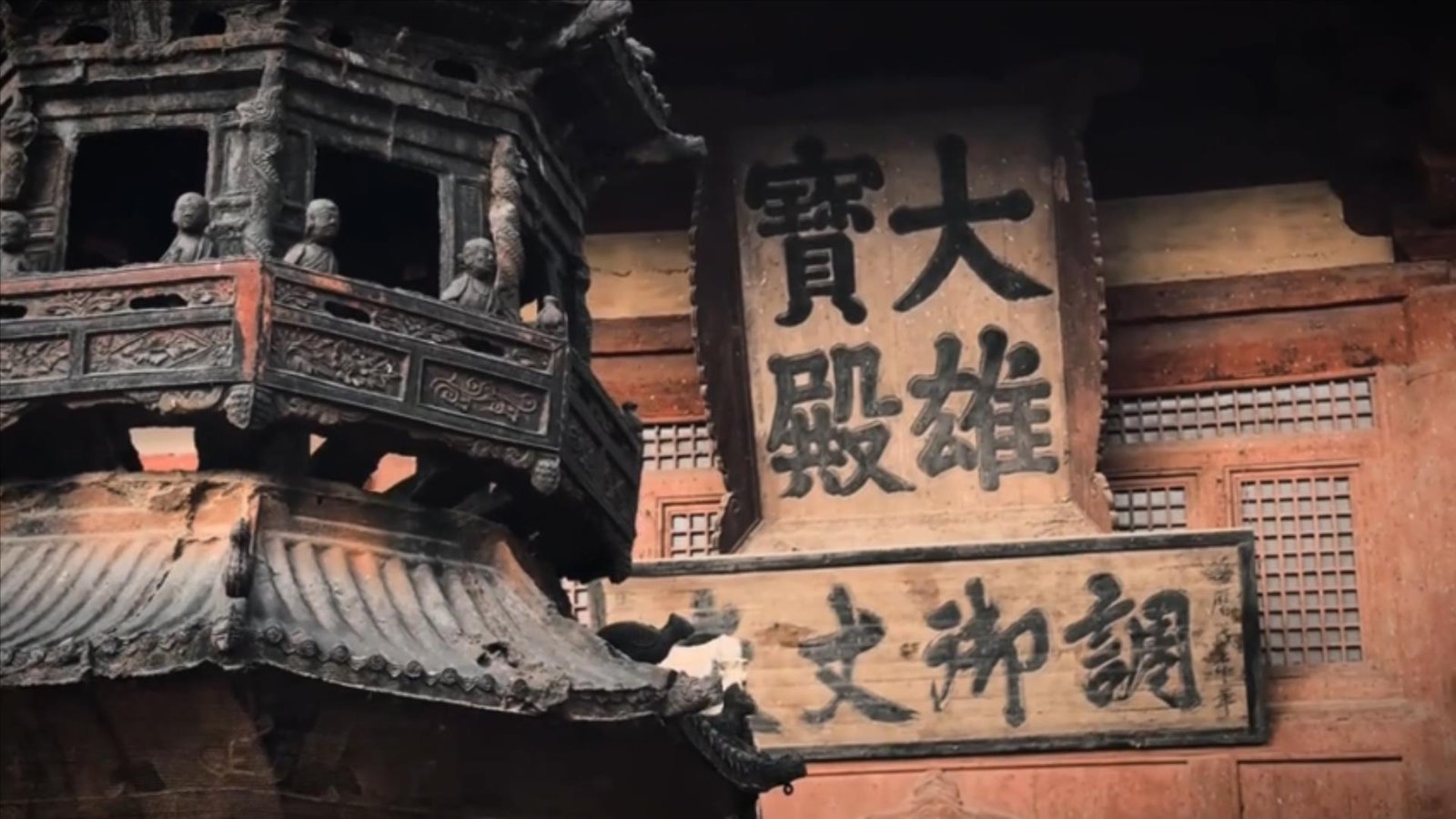
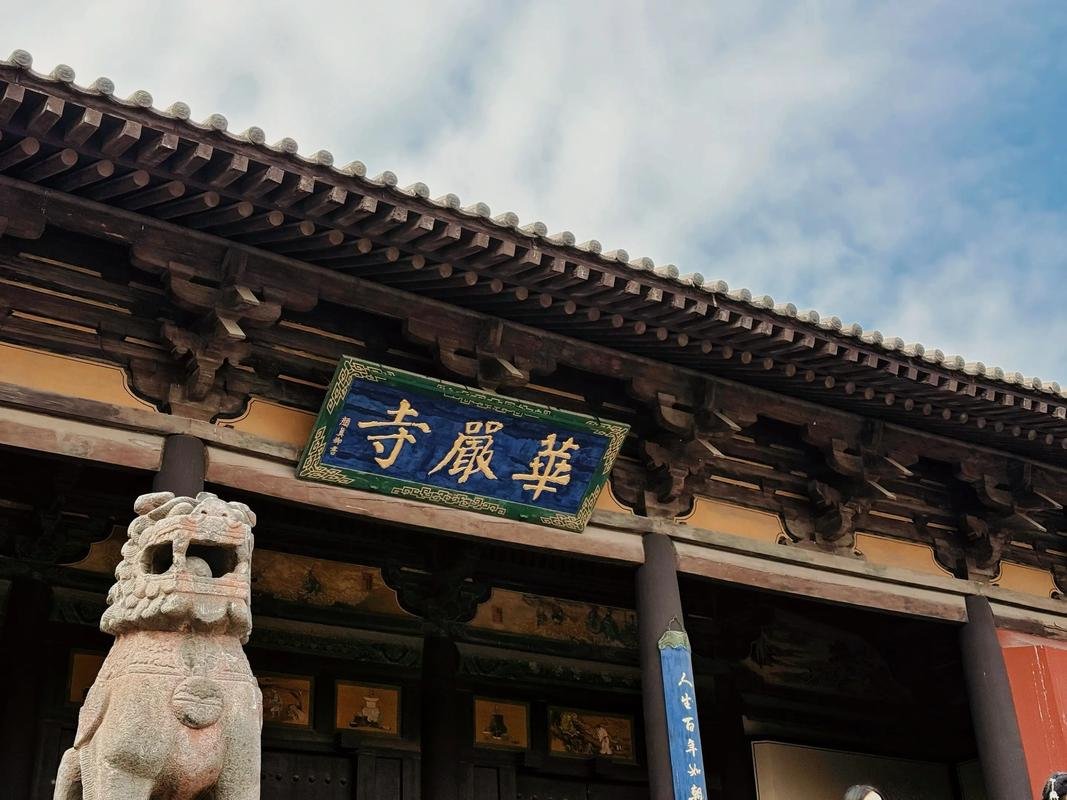
Huayan Temple — The Sun-Worshipping Sanctuary Where a Goddess Smiles
Datong, Shanxi, China | 66,000 m² | Built 1038 | First Batch National Treasure since 1961 | 4A National Tourist Attraction
Most ancient Chinese temples face south. It’s practically a law of religious architecture — all the way from Confucian ritual halls to Buddhist monasteries. Face south. Absorb the sun’s arc across the sky. Obey cosmic order.
The Huayan Temple faces east. Deliberately. Defiantly. Toward the sunrise.
This is your first clue that you’ve entered something built by people who played by their own rules — the Khitan, the semi-nomadic people who founded the Liao Dynasty and worshipped the sun with an intensity that literally oriented their sacred architecture. The temple doesn’t just acknowledge their culture. It embodies it, in timber and tile and nearly a thousand years of stubborn survival.
And inside? China’s largest glazed dragon-ornaments snarling from the roof. The biggest surviving Liao-Jin Buddhist hall in the country. And a bodhisattva so beautiful, so unexpectedly human — lips parted, teeth showing, caught mid-smile — that scholars call her the Venus of the East.
Upper Temple: The Hall That Dwarfs Everything
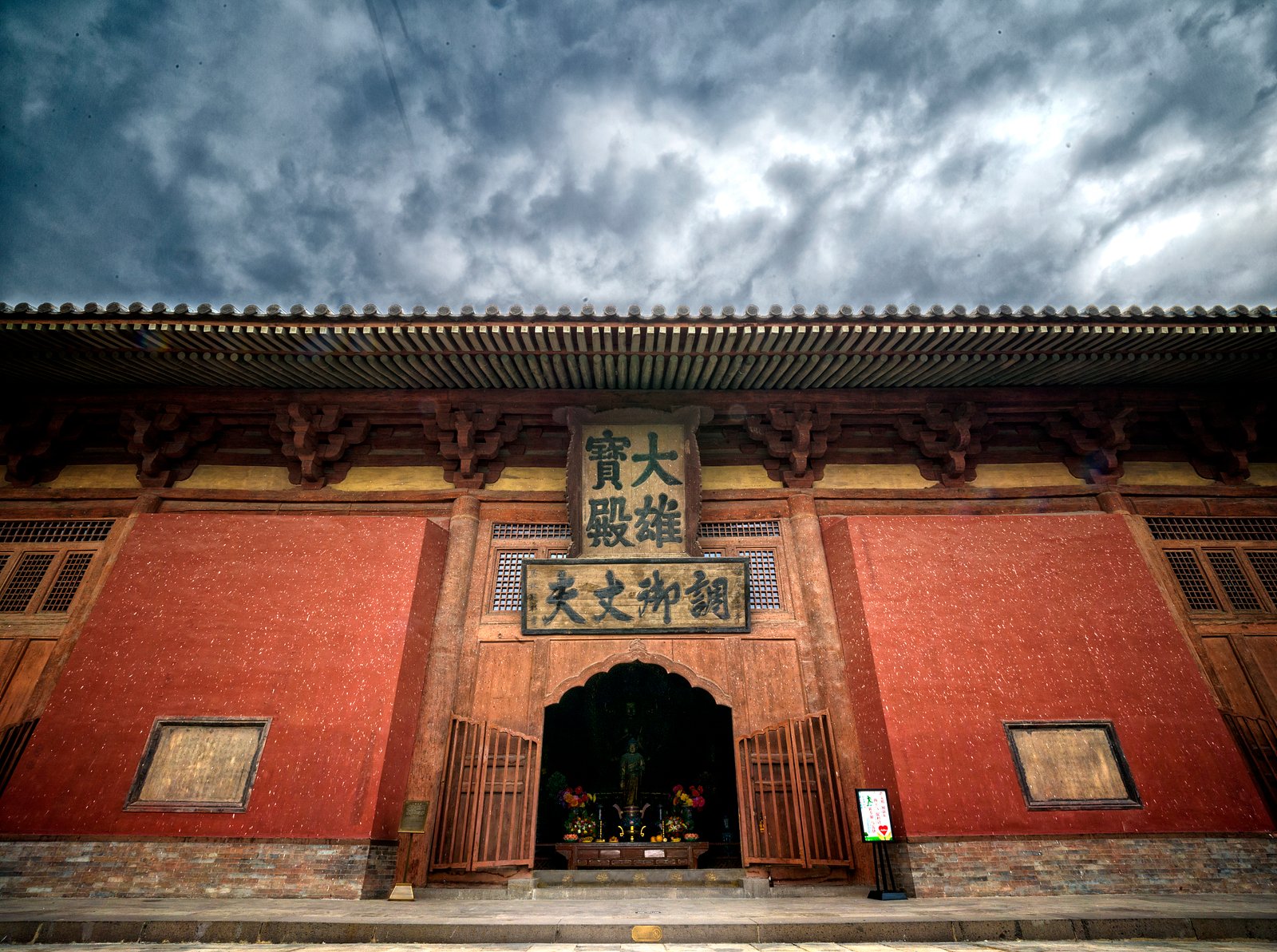
The Mahavira Hall (大雄宝殿) is the kind of building that makes you stop talking mid-sentence.
Nine bays wide — 53.75 meters. Five bays deep — 29 meters. It is China’s largest surviving Buddhist hall from the Liao and Jin periods. The platform alone rises four meters above the courtyard, and when you climb those steps and turn to face the interior, the scale of it — the sheer timber immensity of it — hits like a physical force.
Inside, five colossal Buddhas (the Buddhas of the Five Directions) preside in Ming Dynasty polychrome, attended by twenty-four celestial guardians whose painted bodies lean slightly forward — a technique the sculptors used to make the figures feel engaged with worshippers below, as if they’re bending down to listen. The walls blaze with Qing Dynasty murals, 21 massive panels of Buddhist narrative rendered in mineral pigments that still glow after centuries of incense smoke and candle soot.
Now look up. Actually, step outside and look up.
At each end of the main roof ridge, two glazed chiwen — dragon-headed beasts with gaping jaws — grip the spine of the hall. They are 4.5 meters tall. Each. That’s taller than a mid-size car stood on its bumper. The northern one is the Jin Dynasty original, assembled from eight interlocking glazed ceramic sections, fired nearly 900 years ago. It is the largest ancient glazed chiwen in China — bigger than anything on the Forbidden City’s Hall of Supreme Harmony, bigger than anything in Beijing. It has stared down nine centuries of Shanxi winters, and it looks like it could do nine more without blinking.
Lower Temple: The Bodhisattva Who Smiles
Walk south from the Mahavira Hall, through courtyards shaded by ancient trees, and you reach the Bhagavata Sutra Hall (薄伽教藏殿). This is the temple’s oldest structure — 1038 CE, the Liao Dynasty at its cultural peak, one of the surviving “Eight Great Liao Timber Structures” in all of China.
Inside, arranged across a broad altar platform, stand 31 Liao Dynasty painted clay sculptures — Buddhas, bodhisattvas, disciples, guardian kings, celestial attendants. They were shaped in an age when the Khitan ruled northern China, when Datong was a secondary imperial capital, when Buddhist art was absorbing influences from the Tang, the Song, and the Central Asian steppe into something entirely new. The figures retain Tang voluptuousness but carry a Song-dynasty intimacy, a human warmth that later Buddhist sculpture would lose to formula and convention.
And then there’s her.
She stands barefoot on a lotus pedestal, body swaying slightly, hands pressed together in prayer. Her face is round, her eyes half-closed in meditation, her robes clinging to her figure with the fluid naturalism that only the greatest sculptors achieve. And her mouth — her lips are parted, her teeth are visible, she is smiling.
This is the “Palms-Together, Teeth-Showing Bodhisattva” (合掌露齿菩萨), and she should not exist.
Traditional Chinese decorum demanded that women — let alone female deities — never show their teeth when smiling. It was one of those unbreakable rules, like facing south. The sculptor who made her either didn’t know or didn’t care. What he created instead was something more honest: a young woman lost in spiritual joy, too genuinely happy to remember ceremony, caught in the unguarded moment when ecstasy overrides etiquette.
The historian Zheng Zhenduo called her “the Venus of the East.” Guo Moruo, another towering 20th-century intellectual, called her “an original divine masterpiece.” Neither was exaggerating. She is, quite possibly, the most moving single piece of sculpture in northern China — not because she’s grand, but because she refuses to be. She is intimate. She is alive.
The Library That Defies Gravity
Look past the bodhisattva — or rather, look around her — and you’ll notice something extraordinary happening on the walls.
The perimeter of the Bhagavata Sutra Hall is lined with 38 interconnected sutra-storage cabinets, built as miniature two-story pavilions linked by flying walkways. This is the tian’gong lou’ge (天宫楼阁) — the “Heavenly Palace Pavilion” wall-library — and it is unique. There is nothing else like it in China. Liang Sicheng, the founding father of Chinese architectural history, called it a “unique treasure under heaven” (海内孤品) and wrote about it with the fervor of a man who had just seen architecture crack open and reveal something impossible inside.
The cabinet complex uses 17 different types of bracket sets and 37 different balustrade patterns, none repeated. It is a complete encyclopedia of Liao-era joinery executed in miniature, and it miraculously survived when most of China’s wooden architecture did not. You could spend an hour in this one room and still not see everything the craftsmen encoded into it.
Eastward: The Khitan Sun
Let’s return to that orientation, because it matters more than most visitors realize.
Every major building in Huayan Temple faces east. This was not an accident. The Khitan people who founded the Liao Dynasty maintained a sun-worshipping tradition rooted in their steppe origins. Their tents opened east, toward the dawn. Their sacred ceremonies began at sunrise. When they built a temple, they built it according to their cosmology, not Han convention. Huayan Temple is one of the very few surviving large-scale examples of this cultural imprint in Chinese religious architecture — archaeological evidence of a worldview preserved in wood.
The temple’s name itself comes from the Huayan Sutra (the Avatamsaka Sutra), one of Buddhism’s most philosophically ambitious texts — a scripture of interconnectedness, of infinite worlds within worlds, of every particle containing the whole. The Liao emperors were serious Huayan adherents. They commissioned this temple as an imperial ancestral shrine as well as a Buddhist monastery, installing stone and bronze portraits of deceased emperors alongside the Buddhist images. It was a royal cult site, a scriptural powerhouse, and a statement of Khitan cultural confidence — all in one 66,000-square-meter complex.
What Survived
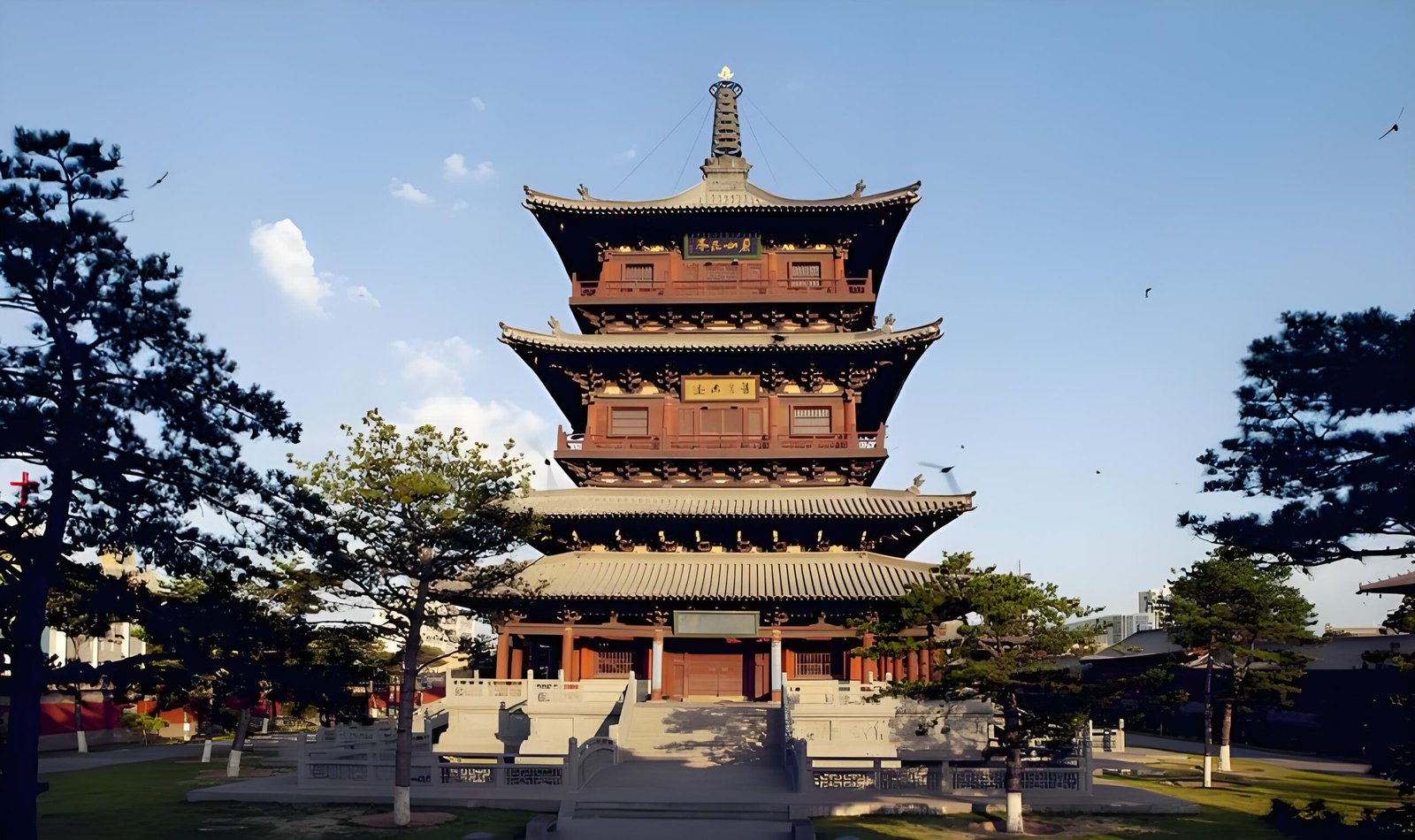
The temple’s history reads like a survivor’s memoir. Built in 1038–1062. Partially destroyed in the chaos at the end of the Liao Dynasty. Rebuilt in 1140 under the Jin Dynasty, including the Mahavira Hall. Damaged again. Repaired by the Ming. Damaged again. Patched by the Qing. By the early 20th century, only the Mahavira Hall and the Bhagavata Sutra Hall remained — two lonely titans amid ruins.

КУЛЬТОВЫЙ
China’s largest and best-preserved Liao Dynasty Buddhist temple — home to the “Venus of the East” (a 1,000-year-old bodhisattva whose smile outlasted an empire), the Bhaga Sutra Cabinet (a miniature heavenly palace carved from wood), and a main hall so vast it feels like standing inside a prayer.
BUZZ
Spotlighted in Black Myth: Wukong, revered as “the soul of Datong,” 4.5+ stars on TripAdvisor — yet still virtually unknown to international tourists walking right past it inside the ancient city walls.

REACH
Inside Datong Ancient City, 5 minutes from the Nine-Dragon Wall — the easiest double-bill in Shanxi: dragons, then divine silence.
ХРОНОГРАММА
Morning light (9–11 AM) streams through lattice windows — April to October ideal, light drizzle enhances the weathered solemnity.

MATCH
Architecture pilgrims, Buddhist art devotees, Black Myth: Wukong fans, and anyone who wants to stand before a 1,000-year-old smile and feel time dissolve — flat terrain, fully accessible.

WORTH
~$8–$10 — rivals Kyoto’s finest at one-tenth the price, with 31 original Liao statues and zero crowds between you and a millennium of silence.