Yingxian Wooden Pagoda
A 67-metre Liao-dynasty tower of interlocking timber, raised in 1056 CE without a single iron nail — the world’s oldest and tallest surviving wooden pagoda, and the third piece of Datong’s Liao-dynasty story after Yungang and the Hanging Temple.
ICONIC
The world’s oldest and tallest surviving wooden pagoda — 67.31 m of Liao-dynasty timber, assembled without a single iron nail, and Guinness-certified in 2016.
BUZZ
Named alongside the Leaning Tower of Pisa and the Eiffel Tower in China’s popular “Three Great Towers of the World” trio — yet it still receives a fraction of their visitors.
REACH
75 km south of Datong in Yingxian County — about an hour by road, or 30 minutes by high-speed rail to Yingxian West plus a 10-minute taxi.
TIMING
Open year-round. 1 May – 31 October: 08:00–18:00 (last tickets 17:30). 1 November – 30 April: 08:30–17:00 (last tickets 16:30). Morning light on the south face is best for photographs.
MATCH
Architecture and timber-frame enthusiasts, photographers, and anyone who has already seen Yungang and the Hanging Temple and wants the third piece of Datong’s Liao-dynasty story.
WORTH
¥50 at the gate or ¥48 online (concessions ¥25, free for 70+ and under 1.2 m) — about 1.5–2 hours, or 3 hours if you also walk to Jingtu Temple next door.
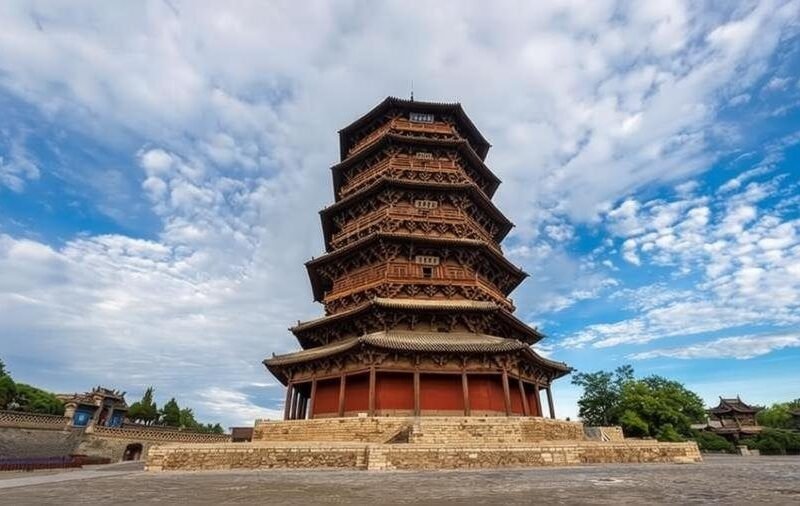
The oldest and tallest surviving wooden pagoda in the world — 67 metres of Liao-dynasty timber raised in 1056 CE, standing in a quiet county town 75 km south of Datong, assembled without a single iron nail.
Introduce
Yingxian Wooden Pagoda — 67 Metres of Timber That Outlasted a Millennium
Fogong Temple, Yingxian County, Shuozhou, Shanxi | Built 1056 CE, Liao dynasty | Guinness World Record certified, 2016
China has older buildings and taller ones. There is nothing else quite like this: a tower of interlocking timber, nearly a thousand years old, that has taken earthquakes, wars and a thousand northern winters and is still standing on its original foundation. Walk one slow circuit around it and you start looking for the trick. There isn’t one — only 54 kinds of bracket, each cut to fit by hand.
The numbers behind the legend
Formally the Sakyamuni Pagoda of Fogong Temple, the tower stands 67.31 m tall on a base 30.27 m across. Its octagonal frame is cut from roughly 3,000 m³ of local red pine, weighing more than 2,600 tonnes. Five storeys are visible from outside; inside, hidden galleries make nine levels in all — a structure Chinese carpenters call ming wu an jiu, “five visible, nine concealed”.
A museum of brackets
What makes the pagoda a pilgrimage for architects is the dougong: the stacked wooden brackets that carry the weight of each eave down onto the columns below. The tower uses 54 distinct types of them, in an octagonal plan with no single load-bearing wall. That is why it is known as the “Museum of Chinese Ancient Architectural Brackets” — and why it flexes instead of cracking when the ground moves. It is regularly named alongside Italy’s Leaning Tower of Pisa and the Eiffel Tower in the popular “Three Great Towers of the World” trio, though it receives a fraction of their visitors.
What you actually see
Because of the tower’s age and the slow lean in its upper storeys, only the ground-floor hall is open. Climbing is permanently closed, and anyone at the gate offering to take you up is selling something that does not exist. What remains is worth the journey on its own: an 11-metre Liao-dynasty Sakyamuni Buddha in the central hall, mineral-pigment murals on the surrounding walls, and a coffered ceiling whose beams have not been replaced in nearly a thousand years.
Outside, walk clockwise around the tower — the traditional direction — and look up. Every tier carries its own board, among them a Jin-dynasty plaque reading “Sakyamuni Pagoda” and another praising its “sublime craftsmanship”. Wind bells hang from each eave. Stand back far enough and the lean in the upper storeys becomes obvious: a reminder that this is timber, not stone.
Getting there from Datong
The pagoda stands 75 km south of Datong in Yingxian County. Most visitors arrive on one of our day tours, which pair it with the Hanging Temple, Mount Heng or the Datong Volcano Group. Travelling independently: high-speed rail from Datong South to Yingxian West takes about 30 minutes, followed by a 10-minute taxi ride; by road it is roughly an hour.
Allow 1.5–2 hours at the pagoda. Free official guided tours run daily at 10:30 and 15:00. If you have time, Jingtu Temple is a 10-minute walk away — a small Jin-dynasty hall with a spectacular carved ceiling that almost nobody visits.
Practical info
- Suggested duration
- 1.5–2 hours (about 3 hours with Jingtu Temple)
- Ticket price
- Approx. ¥48 online / ¥50 at the gate (US$7)
- Opening hours
- 1 May–31 Oct 08:00–18:00 · 1 Nov–30 Apr 08:30–17:00
- Best season
- Year-round — spring and autumn are the most comfortable
Tours including this attraction
Yungang Grottoes · Hanging Temple · Yingxian Pagoda 1-Day Tour
Datong classics in one day
View details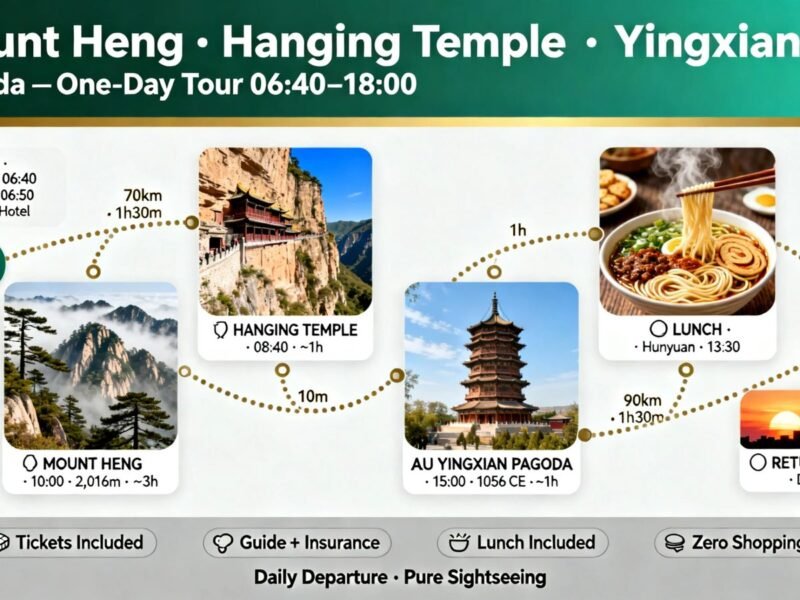
Mount Heng · Hanging Temple · Yingxian Pagoda 1-Day Tour
Sacred mountain, cliff temple and the tallest wooden pagoda
View details
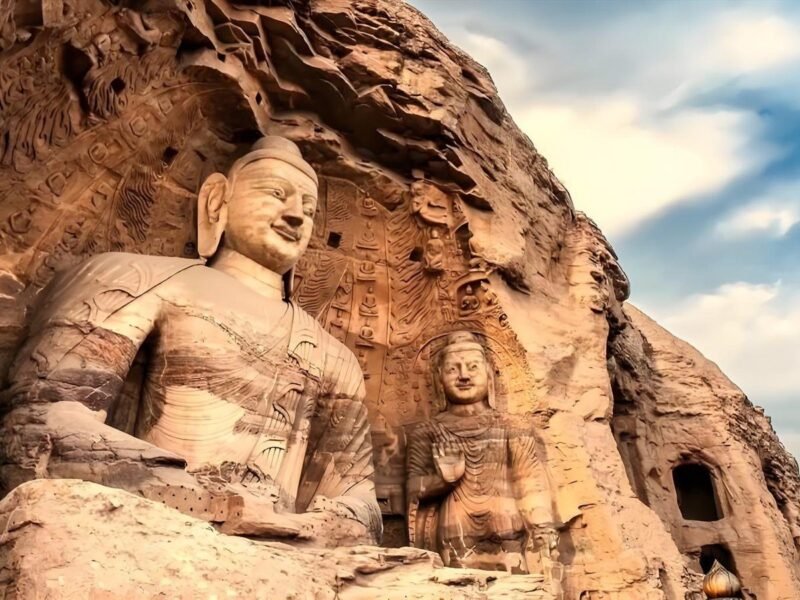
Datong 2-Day Highlights Tour
Tasting the Great Northern Wei — Yungang Grottoes, Datong Museum, Yingxian Pagoda, Hanging Temple & Volcano Group
View detailsTell us about your trip
Leave your dates, group size and interests — we will send a tailored plan and quote within 12 hours (GMT+8).