
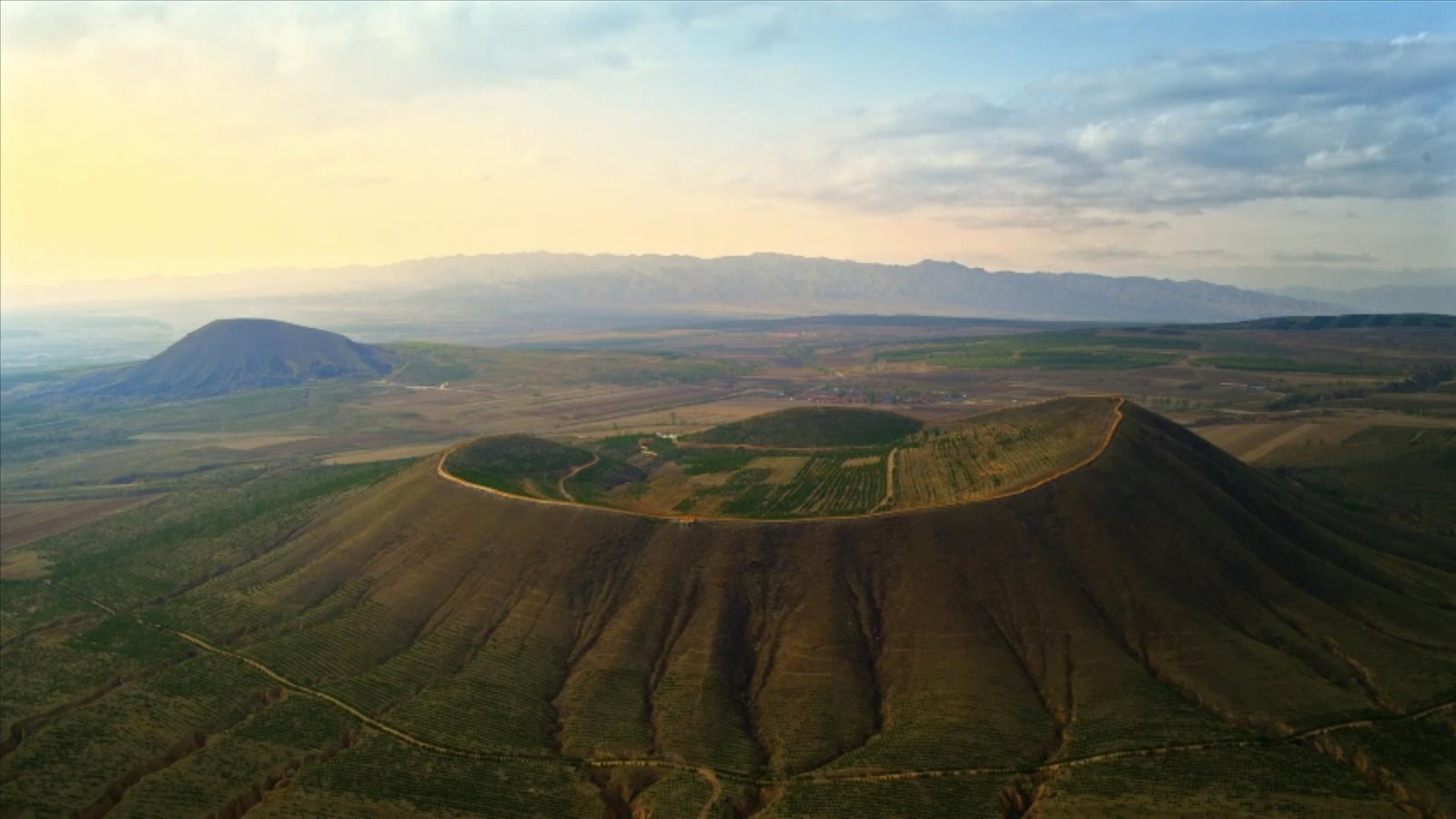
Datong Volcanoes National Geological Park — Earth’s Ancient Fire Frozen on the Loess Plateau
Yunzhou, Datong, Shanxi, China | 129.9 km² | China’s Six Famous Volcanic Clusters | The World’s Only Loess Plateau Volcano Field
Here’s something they don’t tell you about China: it has volcanoes. Real ones. Thirty of them. And they’re scattered across a landscape so surreal — black cones rising from golden loess, craters cupping sky like ancient ceremonial bowls — that geologists call it “the Volcano Geological Museum of China” and “a natural heritage of the East Asian continent.” You’ll just call it the most unexpected day of your trip.
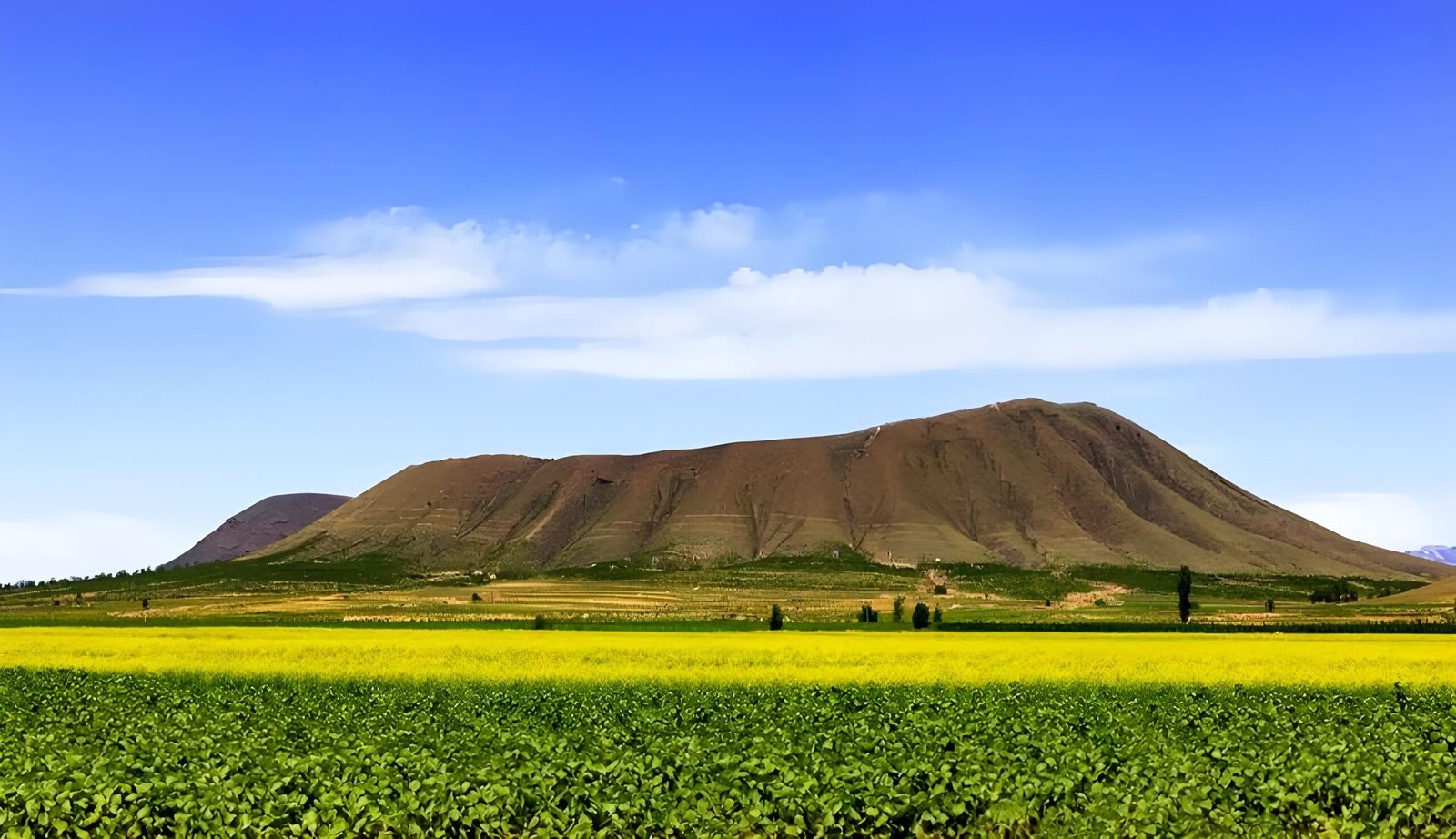
The World’s Only Loess Plateau Volcano Cluster
Let’s clarify what makes this place globally significant, because once you understand it, everything you’re looking at changes.
The Loess Plateau — that vast, wind-blown blanket of yellow silt covering much of northern China — is one of Earth’s most distinctive landforms. Volcanoes, conventionally, don’t happen on loess. They happen on tectonic boundaries, on ocean floors, on basalt shields. But here, in the Quaternary period (roughly the last 2.6 million years), magma punched through the loess and kept punching. The result is a landscape that exists nowhere else on the planet: volcanic cones rising from a sea of yellow earth like islands from an ancient silt ocean.
It is one of China’s six most famous volcanic clusters, and a comprehensive geological park spanning 129.9 square kilometers — part tourism destination, part open-air science classroom, part research site where geologists come to study eruptions that shaped East Asia’s deep past. For the rest of us, it’s a landscape so strange and beautiful you’ll feel like you’ve walked onto the set of a film that hasn’t been made yet.
The Five Mountains You’ll Meet
More than thirty volcanic relief features are scattered across the park, but five cones have earned their names — names so vivid they feel like characters in a folk epic.
Heishan (Black Mountain) — The giant of the cluster, the largest and most imposing cone. Its slopes are dark with basalt, hence the name. The summit crater is well-preserved, and the climb delivers the park’s most commanding panorama. On clear days, you can trace the entire volcanic field — cone after cone, crater after crater — stretching toward the horizon like a geology textbook come to life.
Jinshan (Golden Mountain) — Smaller than Heishan but arguably more beautiful. Sunlight catches its slopes at particular angles, lending the rock a warm, almost metallic sheen. The crater here is shallow and inviting, and the surrounding grasslands turn brilliant green in summer. This is the volcano you photograph at golden hour and then spend the next year showing people.
Langwoshan (Wolf’s Nest Mountain) — This one has atmosphere. The name alone — Wolf’s Nest — tells you something about how local people have imagined this place across centuries. The cone is steep, the crater deep, and standing at its edge, with wind keening across the rim, you’ll understand why wolves feature in the name rather than something more pastoral.
Gelaoshan (Old Man Mountain) — Weathered, eroded, ancient-looking. This cone wears its age visibly, with furrowed slopes and a crater softened by millennia. It has the dignity of something that’s been here since before human memory and will be here long after.
Haotianshan (Heavenly Mountain) — The spiritual one. A temple sits near its summit, and locals have climbed it for centuries to burn incense and pray. The sacred and the geological merge here in a way that’s entirely natural in China but deeply moving wherever you’re from. The crater rim offers views not just of the volcanic field but of the temples and villages below — a reminder that people have lived alongside these sleeping giants for thousands of years.
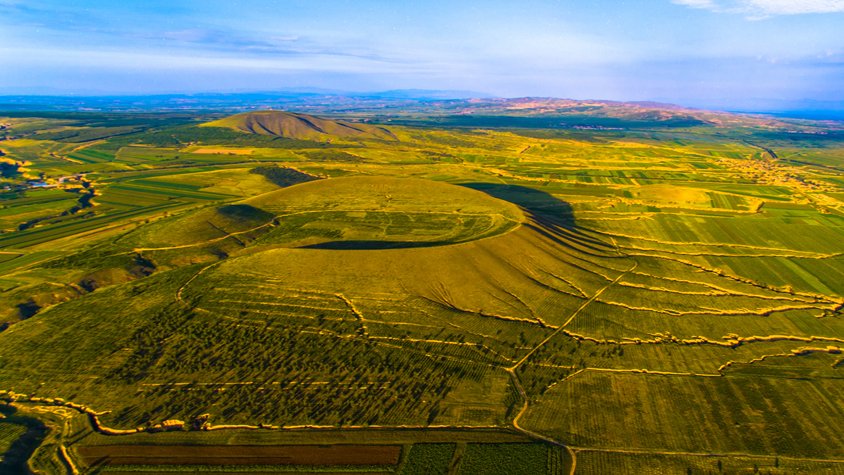
What You’ll Actually Do Here
This isn’t a drive-by, look-out-the-window park. It rewards getting out of the vehicle and engaging.
Climb a volcano. The cones are moderate in height — you’re not scaling Everest. Most are between 100 and 300 meters above the surrounding plain. A good pair of walking shoes and an hour will get you to the crater rim of your chosen peak. The trails are rough in places but manageable for anyone with basic fitness.
Stand inside a crater. The dormant craters are accessible and safe. There’s something uncanny about standing where magma once boiled, now filled with wild grass and wildflowers, the rim a ring of basalt around you. It’s quiet up there. Really quiet. The kind of quiet that makes you aware of your own breathing.
Photograph the impossible. The visual contrast — black volcanic rock against yellow loess, green grasslands, and the impossibly blue Shanxi sky (especially in autumn) — creates compositions you couldn’t plan if you tried. Bring your widest lens. Also bring your longest. The scale shifts constantly.
Village-hop. Small farming communities dot the edges of the volcanic field. Their stone walls incorporate volcanic rock. Their fields extend right up to the cone bases. You can stop for a meal, practice your Mandarin or body-language bargaining for local produce, and glimpse a rhythm of life that has coexisted with these volcanoes for centuries.
Learn the geology. The park’s visitor center (modest but informative) explains the science: the Quaternary eruptions, the basalt flows, the loess layers, the unique conditions that created the only volcanic cluster on a loess plateau anywhere in the world. Signs and exhibits are increasingly available in English.
When the Light Hits Right
There’s a specific hour you need to chase here. Late afternoon, when the sun drops low and the loess glows gold and the volcanic cones throw long shadows across the plain. The entire landscape transforms — from interesting geology to something approaching the sublime.
Plan to be atop Jinshan or Heishan for this. Bring water. Bring a jacket (the wind picks up). Bring patience. The sunset won’t just be beautiful — it will be the kind of beautiful that makes you forget to take pictures because you’re too busy looking.
Sunrise runners, same advice reversed. The cones silhouetted against a pale morning sky, mist pooling in the low ground between them. It’s worth the early alarm.
No Crowds. Really.
Here’s the part that will shock you after fighting through crowds at more famous Chinese attractions: Datong Volcanoes National Geological Park is quiet. Not deserted — but peaceful. Most international visitors don’t know it exists. Most domestic visitors go to the Grottoes and the Hanging Temple and leave. The volcano cluster is the wild card in your Datong itinerary, and it’s all the better for being overlooked.
You might share a crater rim with five other people or fifteen. You might have it to yourself. In 21st-century Chinese tourism, that’s not a perk. That’s a miracle.
The Datong Quadfecta
By now you know the full Datong circuit:
- Пещеры Юньган — Art and faith carved in sandstone.
- Mount Hengshan & The Hanging Temple — Sacred peaks and gravity-defying architecture.
- Древний город Датун — Walled city, chessboard streets, living history.
- Datong City Museum — 170,000 artifacts that explain everything above.
- And now, the volcanoes — Geology, solitude, and the strangest landscape in northern China.
Add a half day for the volcanoes. Go in the afternoon, stay for sunset. It fits perfectly as a break between the cultural density of the grottoes and temples — a session of walking, breathing, and remembering that the earth itself is the oldest work of art in any civilization.
Практический интеллект
Как добраться: The park is in the northeast of Yunzhou County, about 30–40 km from central Datong. Hire a car or take a taxi for the day — it’s affordable (negotiate a day rate of roughly 300–400 RMB with the driver, or arrange through your hotel). Public buses are possible but will eat your time.
Лучшие сезоны: May, June, September, October. Summer can be hot with limited shade. Winter transforms the landscape — snow on the cones, the loess frozen hard, and near-total solitude — but dress for serious cold.
Что взять с собой: Sturdy shoes (volcanic rock is sharp and uneven), plenty of water (limited vendors inside the park), sunscreen and a hat (the Loess Plateau sun is deceptive), layers (wind picks up on the summits), camera, snacks.
Entry fee: Modest (typically under 100 RMB). Combined tickets with other Datong attractions are sometimes available.
Duration: Half a day — enough for 2–3 cones and a leisurely pace. A full day if you want to hike extensively and hit all five named mountains.
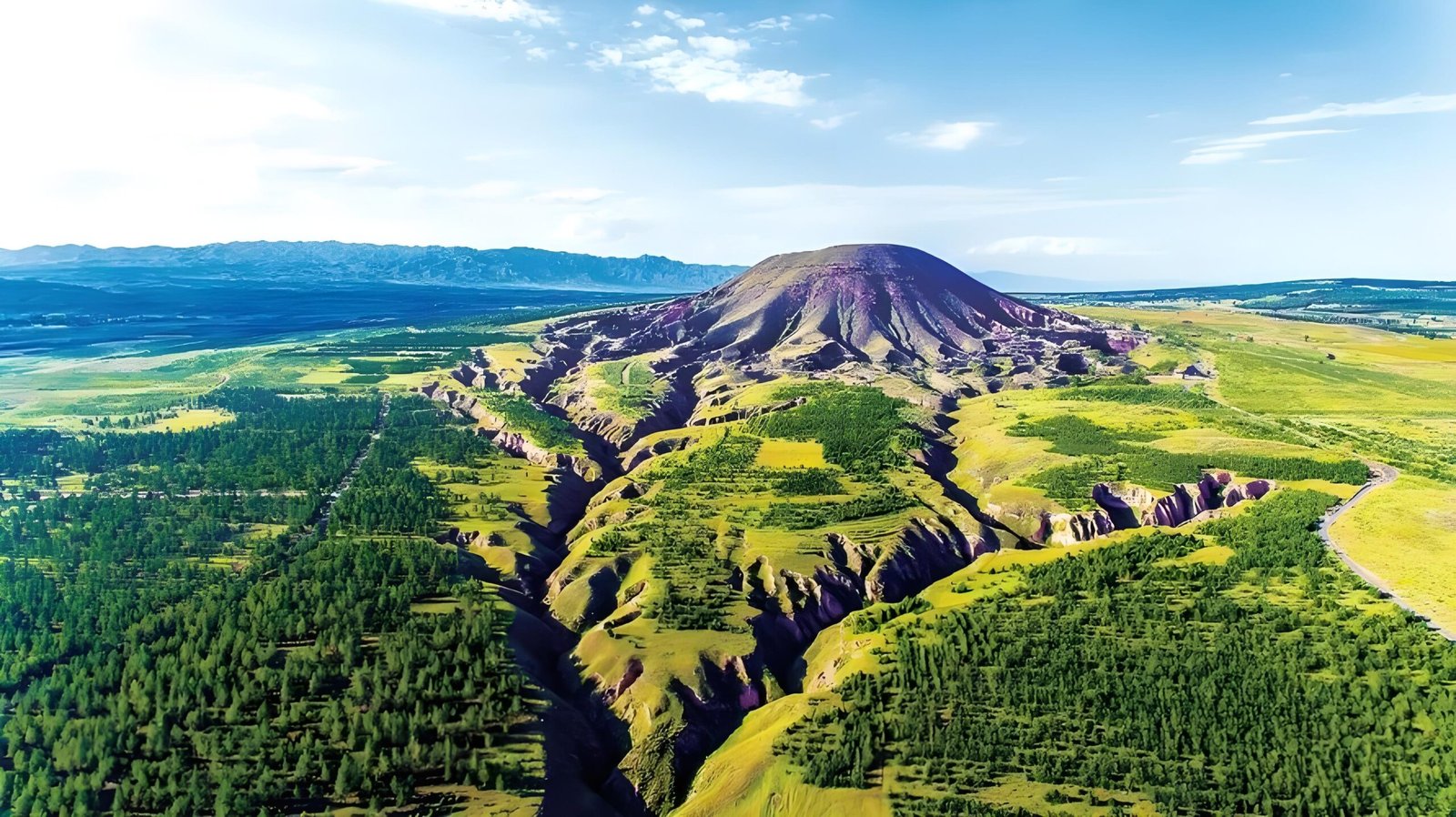
Volcanoes make us feel small, which is the most honest thing a landscape can do. But Datong’s volcanoes do something stranger: they make you feel like the first person to discover them, standing on black rock above golden earth, looking out across a field of sleeping giants that the world forgot to visit. Don’t forget. Go.

КУЛЬТОВЫЙ
Over 30 extinct volcanoes scattered across the Loess Plateau — walk straight into a 100,000-year-old crater and stand where the earth once tore itself open.

BUZZ
“Mars on Earth, without the CGI” — rising star in adventure photography, increasingly compared to Iceland’s volcanic fields by travelers who’ve seen both.

REACH
30 km east of Datong, ~40 minutes by car — the wild card that transforms a cultural trip into a geological adventure.

ХРОНОГРАММА
Sunrise or sunset non-negotiable for photography. Spring/autumn best. Summer midday = frying pan. Winter = eerie alien snowscape

MATCH
Geology geeks, drone photographers, hikers who collect rare landscapes — moderate fitness, strong winds challenge drones, not for small children on exposed ridges.

WORTH
Free or under $5 — for less than a cup of coffee, stand on a crater rim older than human civilization.