
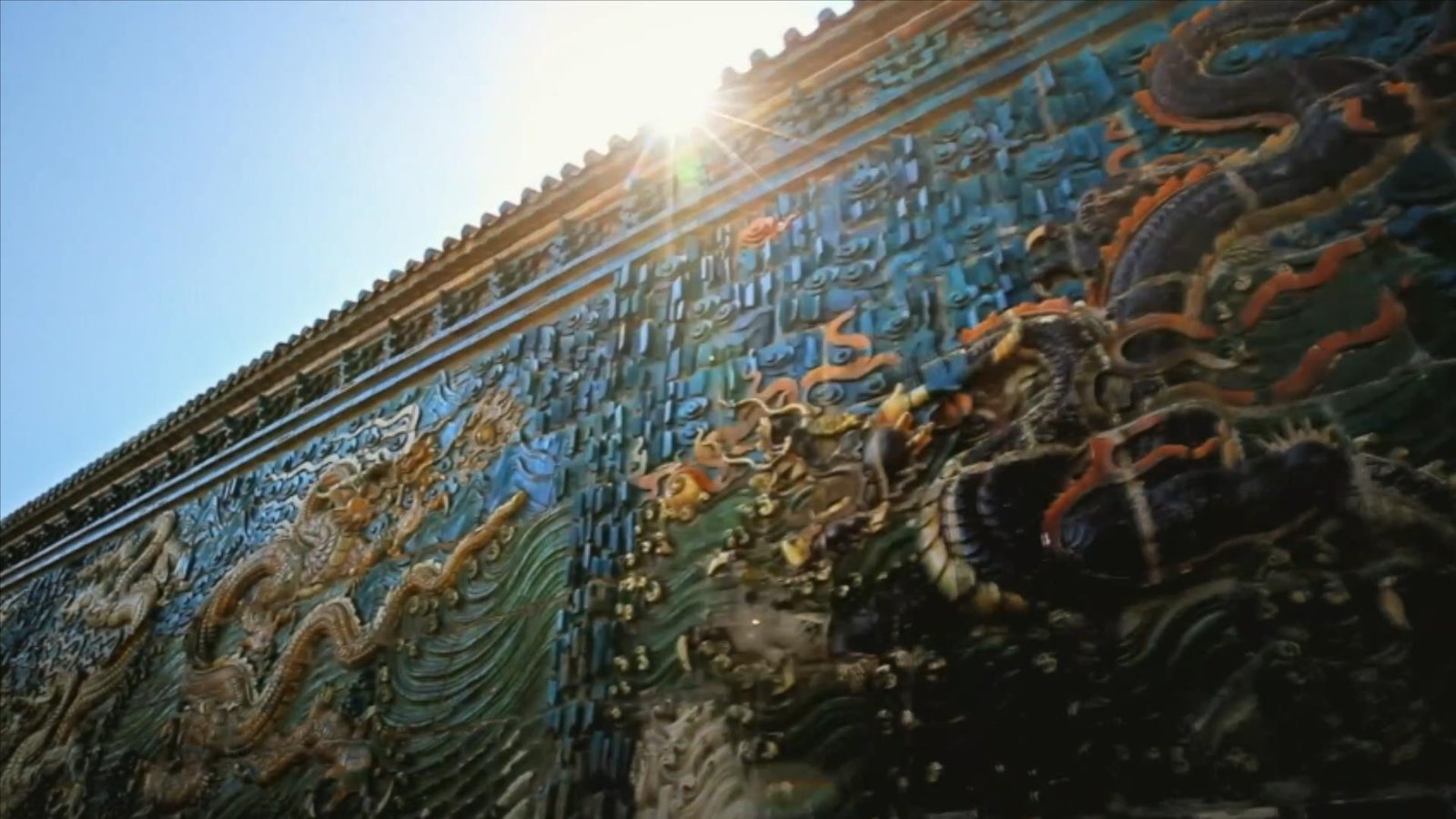
Nine-Dragon Wall — The Oldest, Largest Dragon Wall in China, Hidden in Plain Sight
Datong, Shanxi, China | 45.5 Meters of Ming Dynasty Majesty | China’s Greatest Glazed Dragon Wall | National Treasure since 2001
Walk east along Heyang Street inside Datong’s ancient city walls, and you’ll come across something that stops you mid-stride. It’s a wall. A very big wall. Covered in nine colossal dragons, each twisting through clouds and waves in peacock blue, imperial gold, and deep purple — frozen mid-roar for over 600 years.
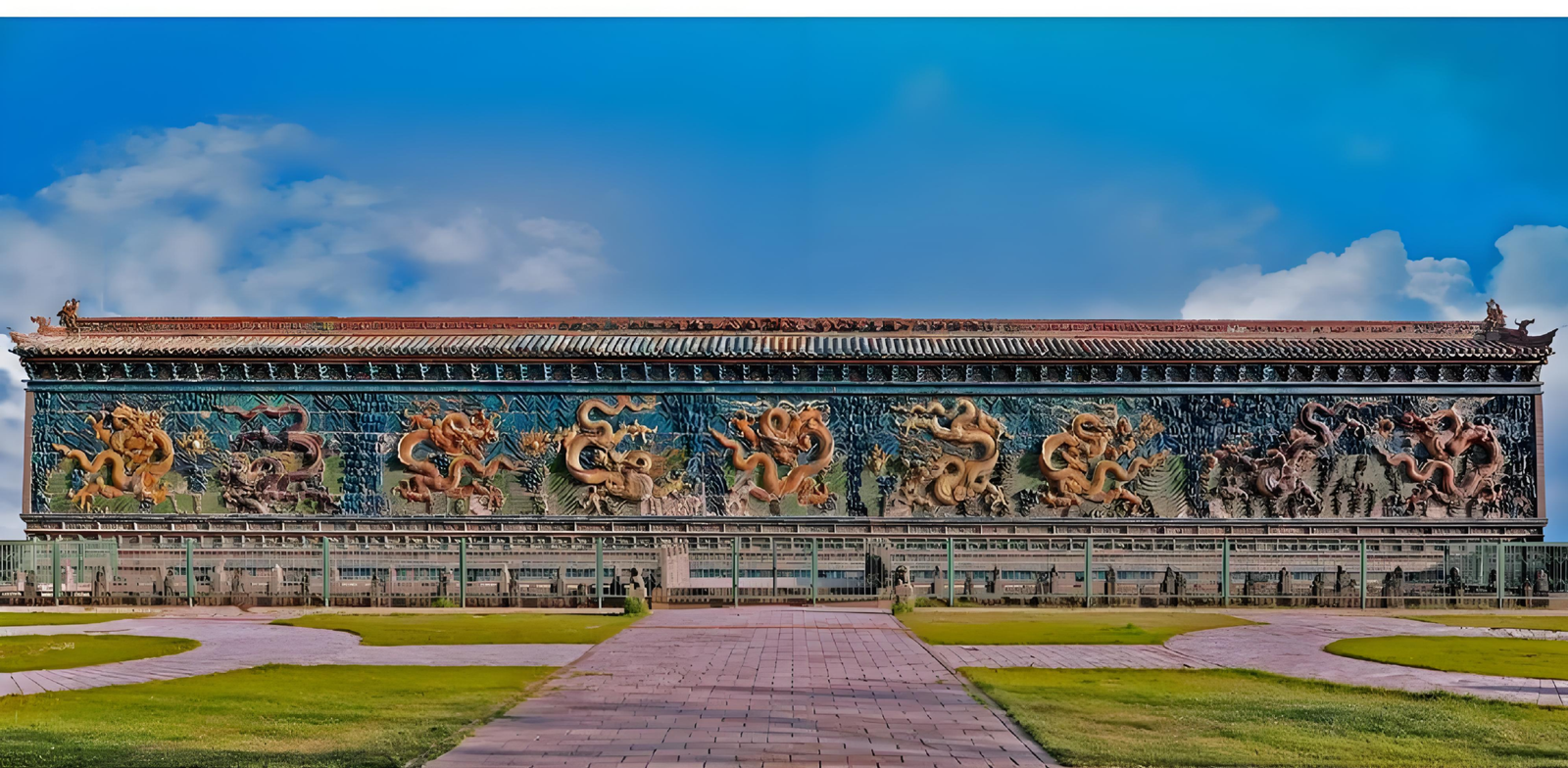
This is the Datong Nine-Dragon Wall. It is the oldest and largest of its kind in all of China. It predates the famous Nine-Dragon Walls in Beijing’s Forbidden City and Beihai Park by three and a half centuries. It is roughly four times the size of the Beihai one. And unlike its Beijing cousins, which require tickets, timed entries, and queue management, this one sits quietly on a Datong street, waiting.
A Prince, His Palace, and a Dragon Wall Too Big to Destroy
The wall was built between 1392 and 1396 — the final years of the 14th century — for a man with a problem. His name was Zhu Gui, the 13th son of Zhu Yuanzhang, the peasant-turned-rebel who founded the Ming Dynasty. Zhu Gui was named Prince of Dai and dispatched to Datong in 1392 to govern the northern frontier. He was rich. He was powerful. And he wanted everyone who approached his palace to know it.
The solution: a zhaobi — a spirit screen wall — placed directly in front of his mansion gates, facing the street. Not a modest one. Not a tasteful one. A wall 45.5 meters long, 8 meters high, 2 meters thick, surfaced with 426 specially fired polychrome glazed tiles, upon which nine dragons writhe in high relief against a backdrop of churning oceans, rolling clouds, rising sun, and crescent moon.
The dragons have four claws, not five. Zhu Gui was a prince, not the emperor, and in Ming iconographic law, that missing claw was everything. It declared: I am powerful, but I know my place. The wall was his ambition and his deference, baked together in colored glaze.
Then, in the chaos at the end of the Ming Dynasty, the Prince of Dai’s palace burned to the ground. Military fire. Everything gone — the halls, the gates, the courtyards. Everything except the dragon wall. It survived, standing alone amid the rubble, nine stone dragons still roaring silently at nothing. If that’s not a metaphor for something, I don’t know what is.
Nine Dragons, 426 Tiles, 600 Years
Let’s get close. You’ll want to.
The wall divides into three sections: a carved stone base (the xumizuo, or Sumeru pedestal, decorated with lions, deer,麒麟, and smaller dragons), the main dragon panel, and a tile roof with 62 sets of glazed bracket arms supporting a single-eaved, five-ridged top.
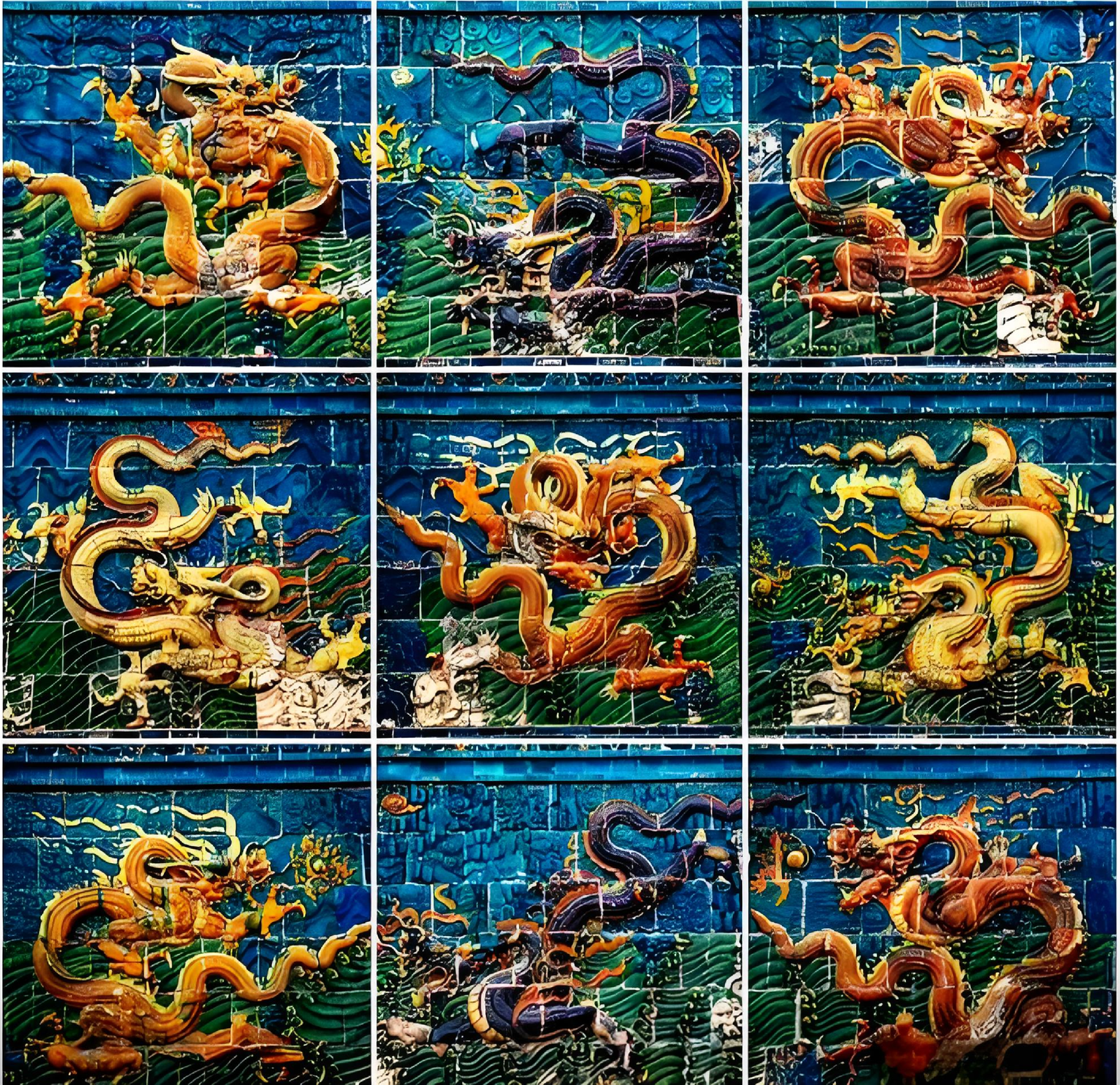
But it’s the main panel that owns your attention. Nine dragons — each sculpted in high relief, each distinct in pose and personality — surge across the surface. One opens its jaws around a flaming pearl. Another coils protectively around the same treasure. A third twists backward as if startled. They are separated and connected by waves, cliffs, clouds, and mountain peaks — the whole composition in constant motion despite being set in fired clay.
The color palette is the Ming Dynasty at full volume: peacock blue skies, green-black waves, and dragons in vivid yellow, ochre, amethyst, white, and brown — each scale outlined, each whisker defined, each claw sharp enough to still look dangerous. At the east end, the sun rises. At the west end, the moon hangs over the sea. Between them, nine dragons hold dominion.
The construction technique is ingenious. Each of the 426 glazed tiles is hollow, threaded onto wooden dowels that run through the wall, locking the entire surface into a single, stable mass. It’s why the wall survived when the palace didn’t.
And in front of the wall? A long rectangular reflecting pool. When the water is still, nine dragons gaze back at themselves. When a breeze stirs the surface, they shudder and swim. It’s one of the simplest, most brilliant artistic decisions in Chinese architecture — a static wall made dynamic by nothing more than water and wind.
The King of Dragon Walls
There are three famous Nine-Dragon Walls in China. Datong’s is the first among equals:
- Datong Nine-Dragon Wall (1392–1396) — The original. The biggest. 45.5 meters, 426 tiles, Ming Dynasty, built for a frontier prince.
- Beijing Forbidden City Nine-Dragon Wall (1773) — Imperial, exquisite, five-clawed dragons, built for an emperor.
- Beijing Beihai Park Nine-Dragon Wall (1756) — Magnificent, two-sided (dragons on both faces), but only a quarter of Datong’s size.
Datong’s wall is older than both by roughly 350 years. It is larger than both combined. And while the Beijing walls live behind ticket barriers and crowd ropes, Datong’s wall sits on an open city street — part of the living fabric of the ancient city, not sealed away from it. You can walk up to it at 7 a.m. with a street breakfast in hand and have the dragons to yourself.
In 2001, it was named a National Key Cultural Relic Protection Unit — the highest heritage designation in China, and long overdue.
The “Nine-Dragon Wall” Was Not Actually Legal
Here’s the delicious subplot.
Zhu Gui, the prince who built this wall, was not a model aristocrat. Historical accounts describe him as temperamental, entitled, and frequently at odds with imperial protocol. The dragon wall itself pushed boundaries — it was ostentatious even by Ming princely standards. Some sources suggest he essentially browbeat (or “noisily demanded,” as one account puts it) the court into approving construction.
The four-clawed dragons were his attempt to stay within the rules while still making something that screamed look at me. It worked. Six hundred years later, we’re still looking.
Where This Fits in Your Datong Circuit
The Nine-Dragon Wall is inside Datong Ancient City, on Heyang Street (the main east-west road leading to the eastern gate). You can walk to it from Sipailou — the Four-Archway Building at the city’s center — in about five minutes. It fits naturally into your walled-city exploration day:
- Morning: Walk or bike the city wall (the full 7.24-km circuit).
- Late morning: Explore the temples and courtyards of the chessboard grid.
- Afternoon: The Nine-Dragon Wall, then a branch museum or two (the Datong City Museum’s main hall or the Liang Sicheng Memorial Hall are nearby).
- Evening: Food, lanterns, tea — Datong’s streets at night are half the reason to come.
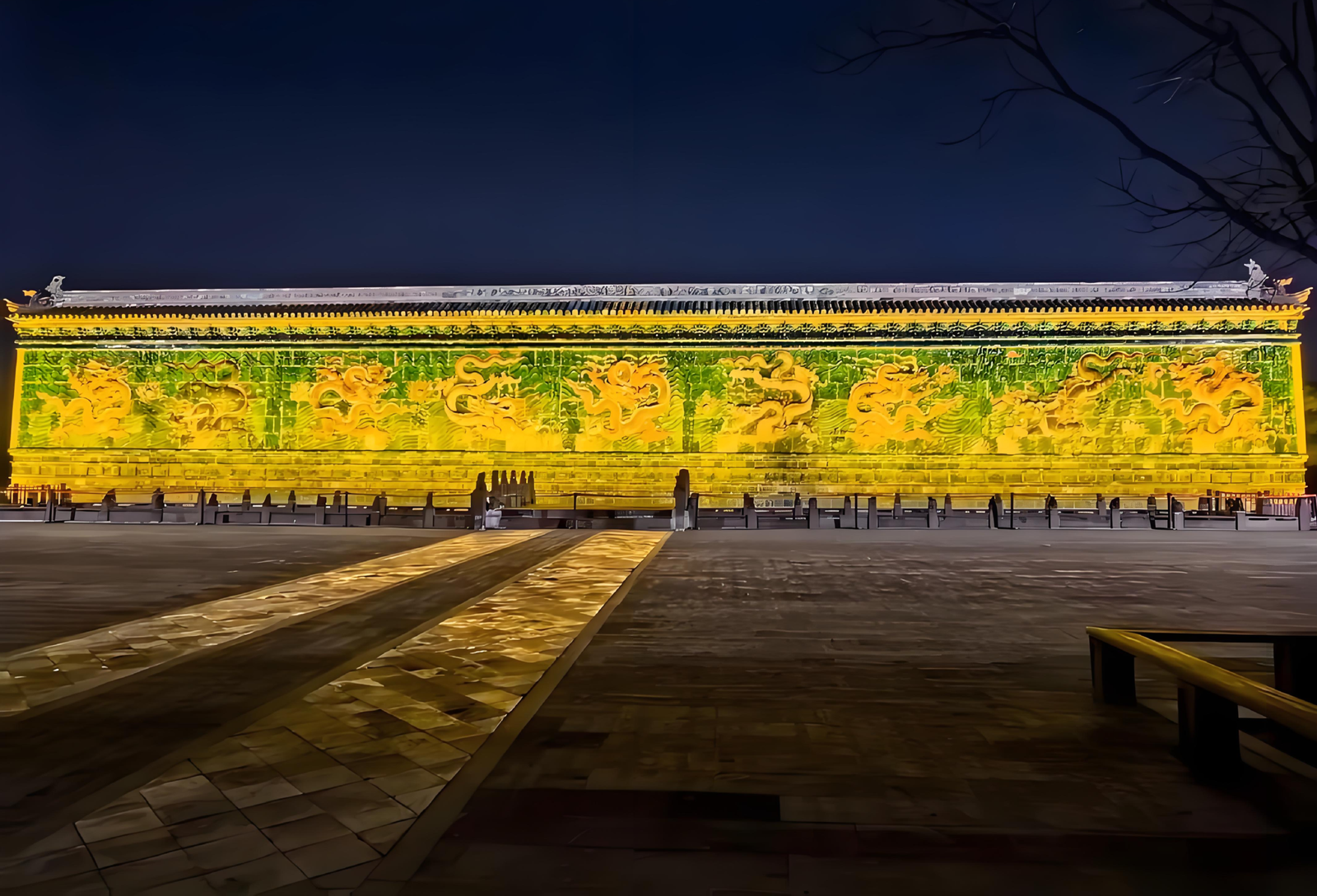
Better yet, visit the wall twice. Once in daylight, to study the dragons up close. Once at dusk, when the setting sun catches the glaze and the dragons seem to smolder from within.
Как добраться: Heyang Street (和阳街), inside Datong Ancient City. Walkable from anywhere within the walls. No ticket required — it’s visible from the street, though access to the immediate forecourt may involve a small fee (typically under 30 RMB).
Best time: Any daylight hour. Late afternoon light is spectacular on the glazed surface. The reflecting pool is most effective in still weather.
Photography tip: Morning light favors the eastern dragons (and the sun motif on that end). Afternoon light warms the western dragons and the moon panel. Choose your allegiance.
Most monuments insist on their own importance with height and mass. The Nine-Dragon Wall does it differently — it stretches out, lies low, and lets nine dragons do the shouting. Six hundred years of fire, war, and regime change have passed around it. The palace fell. The prince died. The empire ended. But the dragons are still there, still roaring, still waiting on a quiet street in Datong for you to stop walking and start looking.

КУЛЬТОВЫЙ
The largest, oldest, and most magnificent glazed Nine-Dragon Wall in all of China — a 45-meter-long, 600-year-old Ming Dynasty screen of nine imperial dragons frozen mid-pursuit across a sea of turquoise ceramic waves, built for a prince who never became emperor.

BUZZ
The unsung champion of Chinese dragon walls — bigger than Beijing’s Forbidden City version, older than Beihai Park’s, yet somehow still a footnote — slowly gaining cult status among architecture tourists and ceramic art lovers worldwide.

REACH
Inside Datong Ancient City, a 5-minute walk from the Drum Tower — literally on the way to everything else, making it the easiest zero-effort detour in your entire Datong itinerary.

ХРОНОГРАММА
Midday sunlight makes the glazed tiles explode with color — the golden dragons catch fire, the green waves shimmer, and you’ll understand why ceramic artists spent years perfecting a single tile. Overcast days work too, but direct sun is the secret sauce.

MATCH
Architecture detail hunters, ceramic art fans, Instagram minimalists chasing that one perfect detail shot, and anyone who appreciates that the best things in travel are often the things you stumble upon between other things.

WORTH
Under $2 or free — for a 600-year-old national treasure that beats its more famous cousins in Beijing on every measurable dimension except fame.